$50 Million Housing/ Retail/ Healthcare Development headed to the AUC

For years, AUC students have made the long desolate walk down Westview Drive/Lee Street between the AUC and the West End Commercial Corridor to get hangers and the new Jordans in Mall West End or hop on the Marta at West End station and head to Lenox.  They used to tell students not to walk alone. Well, that walk is about to become a lot more scenic.

Morehouse School of Medicine just announced a more than $50 million expansion adjacent to its southwest Atlanta campus in the Atlanta University Center (AUC.)

The new development on Lee Street will be built on land that was formerly occupied by the long gone, Harris Homes housing projects. It will include a 5-story building with 200 market rate housing units, an ambulatory health-care center, a parking garage, and retail space.  It will be completed by 2020.
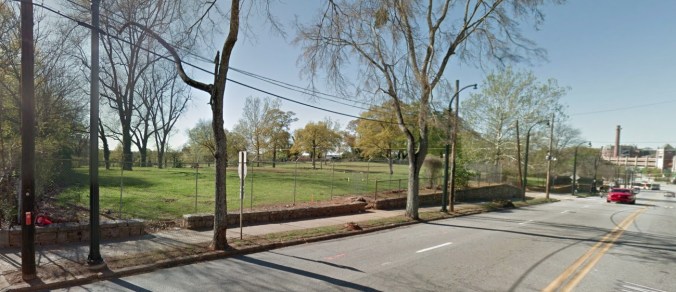
MSM Lee Campus

Dr. Valerie Montgomery Rice, president of MSM, said the Lee Street Campus will solidify the school’s role in revitalizing Atlanta’s Westside. “We’re becoming a part of what we like to describe as ‘the Westside story,’” Rice said. “Our ideas have been independent of what is happening with the [Mercedes-Benz Stadium], but this is what we feel we can contribute to the development of the Westside.”

Real estate developer Carter USA won the bidding process to develop the first phase of the project, which MSM is calling the Lee Street Campus. The first phase includes the construction of a three-story commercial building that will house a student health and wellness clinic as well as an ambulatory care center that will be open to the public. Morehouse School of Medicine will partner with a national fitness center chain to develop a 24-hour center on the building’s top floor.

The new housing will make life easier for Morehouse’s medical students, who spend the majority of their first two years on campus. “We looked at this parcel of land we owned and thought the most important thing we could do for our students was allow them to have more affordable housing close to the school,” Rice said.

Carter Developments will also build a five-story building with approximately 200 market-rate units, most of which will be one or two bedrooms. “We’ve looked at what our students are typically paying, but we also want it to be apartments anyone would want to live in — high quality with smart technology,” Rice said.

The units are needed to accommodate MSM’s growing student population, which surpassed 520 this year, including 100 incoming medical students. When Rice began her presidency in 2011, the school had only 56 incoming medical students.

Plans also call for a 347-space parking deck and retail space for restaurants and other amenities.

The development will rise on vacant land MSM acquired during a 2006 land swap between the Atlanta Housing Authority and College Partners Inc., a collaboration between MSM, Spelman College and Morehouse College. The land swap included about 11 acres of the former Harris Homes public housing community, as well as various parcels of private land that added up to about 20 acres.

MSM acquired 7.3 acres during the swap, and 2.9 acres of the parcel will be developed during the first phase. The school is still weighing its options for the remainder of the property, though Rice predicts it will need to add more market-rate housing to keep pace with the growing student body size.

The school won’t own the mixed-use development. Instead, it will enter into a 99-year ground lease with Carter for the first phase, though the school potentially could become an equity partner in the project.
Read More…

msmexpansionvmrtaylor

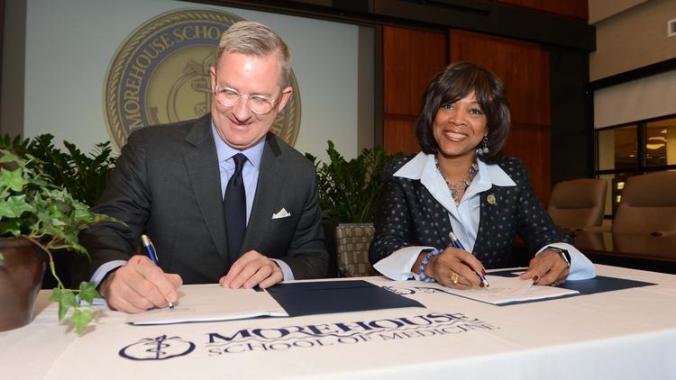
Carter Developments President & CEO Scott Taylor and Morehouse School of Medicine President  
Dr. Valerie Montgomery Rice sign $50 million MSM expansion deal.                                                Photo Credit: Byron E. Small/ Morehouse School of Medicine
Loft office, Artist studios, Coffee shop, & Affordable Housing Slated for Adair Park

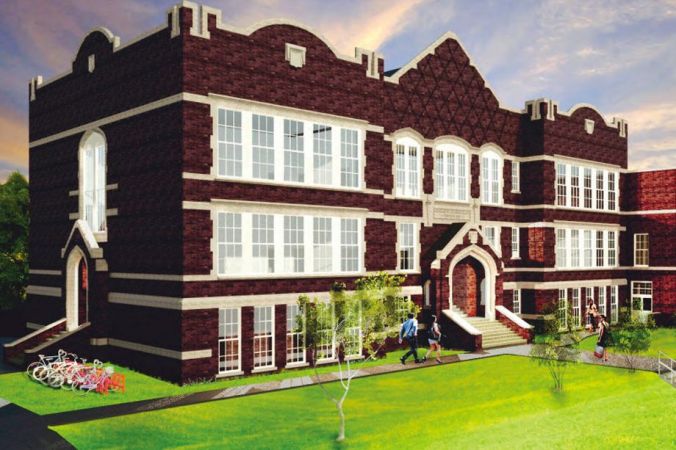
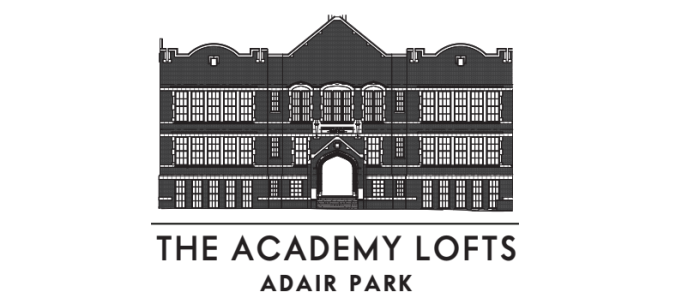
Adair Park is the latest Downtown West neighborhood to receive some much needed economic development and housing. After years of fighting with Atlanta Public Schools over control of an abandoned schoolhouse in Adair Park, the century old building will be renovated and become The Academy Lofts.

Academy-Drawing.jpg-2

The Academy Lofts are slated for completion in early 2019.

According to Curbed Atlanta, in addition to 5,000 square feet of loft offices for small businesses, artist studios and a 1,300-square-foot coffee shop, the historic redevelopment project will create 35 “micro-units” of affordable “art-force” housing (reserved for artists)—and is utilizing a $1.5-million grant from Invest Atlanta as part of the Housing Opportunity Bond Program—in order to maintain affordability into the future. Funding will also come through historic tax credits.

Adair_Park_School.png.0

Slated for completion in early 2019, the project is using local developers, Stryant Investments and Building Insights who have partnered with arts nonprofit The Creatives Project to bring new life to the school, which has been abandoned for nearly 45 years. The auditorium will be converted into an art gallery and community events space.

Neda Abghari, executive director of the Creatives Project, said the concept is the first of its kind in the City of Atlanta. Read more and see renderings …

Several New Affordable Homes Headed for English Avenue

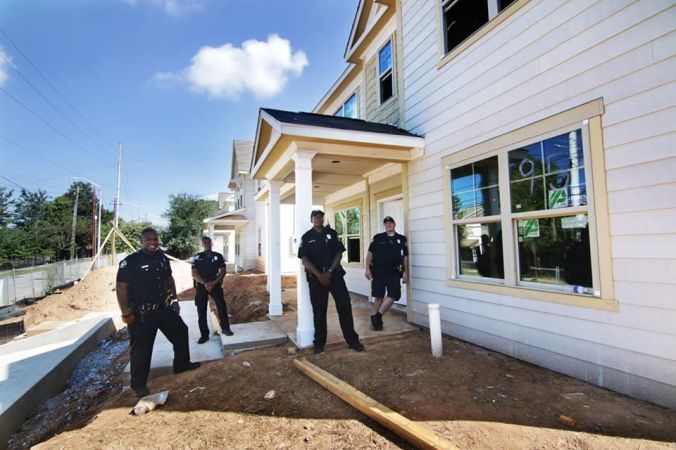
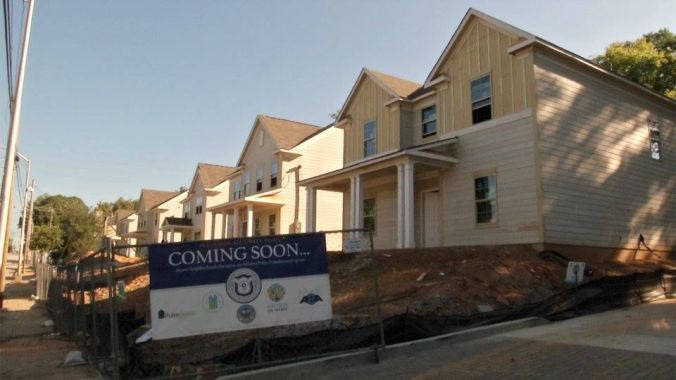
After the successful construction of 5 affordable homes along James P. Brawley Dr. NW in Vine City earlier this year (Phase I), the Atlanta Police Foundation has embarked on an even more ambitious project in neighboring English Avenue. In Phase II, a total of 20 newly constructed homes are planned for police officers and long-time neighborhood residents.

Griffin_Street_Apartments

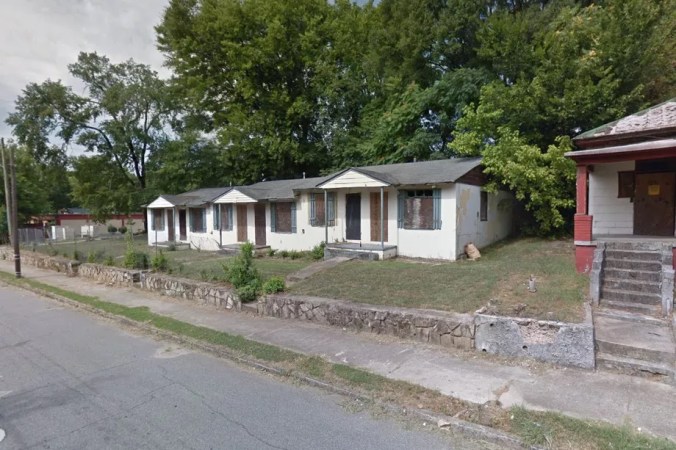
Blighted apartments on Griffin Street have been demolished for new construction.

Demolition has already been completed of previously dilapidated homes and work is underway on Griffin Street to build several new homes for police officers and legacy residents, according to the Atlanta Police Foundation. The initiative, known as Secure Neighborhoods, is supported by the City of Atlanta, the Arthur M. Blank Family Foundation, and Westside Future Fund and is targeted towards three specific neighborhoods: Vine City, English Avenue, and Pittsburgh.

14657314_1843128382583026_3256136458837894640_nIn addition to removing blight and adding new residents to the Historic Westside communities, the Secure Neighborhoods programs seeks to increase police visibility, build connections between police and neighbors, and provide housing options for officers.  And its already seeing success; the Westside has seen a significant reduction in crime.
The organization is based on a public-private partnership model that has worked to secure and leverage private resources to fund high priority projects designed to enhance the City of Atlanta’s ability to fight and prevent crime. As a result of the work of the APF, since 2003 there has been an increase in the number of police officers on the streets and an increase in the engagement of Atlanta’s business community and neighborhood residents in fighting crime. Additionally, the City has experienced a 58 percent reduction in the violent crime rate and a 41 percent reduction in crimes overall.

14720542_1843136982582166_3560788328946588158_n

Another 10 homes are expected to be built as part of phase III in 2018. By 2020, the project will have constricted 35 new homes in downtown west.


Another New Park to Be Built in Vine City

It is being reported that a 4 acre park, Boone Park West,  will be built in Vine City.  This is the second park to be announced this year.  This past spring construction began on the Rodney Cook Sr. Park.

Boone Park West Compile (1).JPG

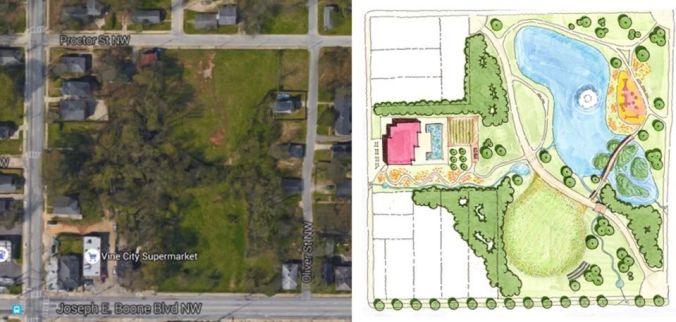
Boone Park West sit at the intersection of Oliver St. NW and Joseph E Boone Blvd. 

Construction of Boone Park West  will include the conversion of  a collection of abandoned and neglected parcels into a “positive, vibrant, and transformative public space” that engages the community in green infrastructure solutions, increases public access to recreational opportunities, provides jobs and training for residents, improves environmental quality, and reduces negative impacts of stormwater runoff, according to a report by Park Pride.

Curbed Atlanta and Saratoga Report both reported that the plans to create Boone Park West in the Proctor Creek Watershed. The plans show the proposed site will carve out space for the future home of the Atlanta Urban Ecology Resource Center (AUERC).

The new park is just one of many within the watershed that could help address issues of flooding in neighborhoods like English Avenue and Vine City. One of the primary purposes of Boone Park West is to control localized flooding around the park site and provide capacity relief for the sewer system around this westward edge of Downtown  Atlanta.

According to Park Pride officials, the park will be the third on the westside (after Vine City Park and Lindsay Street Park) built as part of the Proctor Creek North Avenue Vision for Green Infrastructure study completed in 2010.

Said officials in a release: “A key component of Boone Park West will be a green infrastructure amenity designed to capture, clean, and infiltrate at least 37,500 cubic feet of stormwater runoff from the surrounding streets, mitigating the recurrent flooding that has historically plagued these neighborhoods.”